
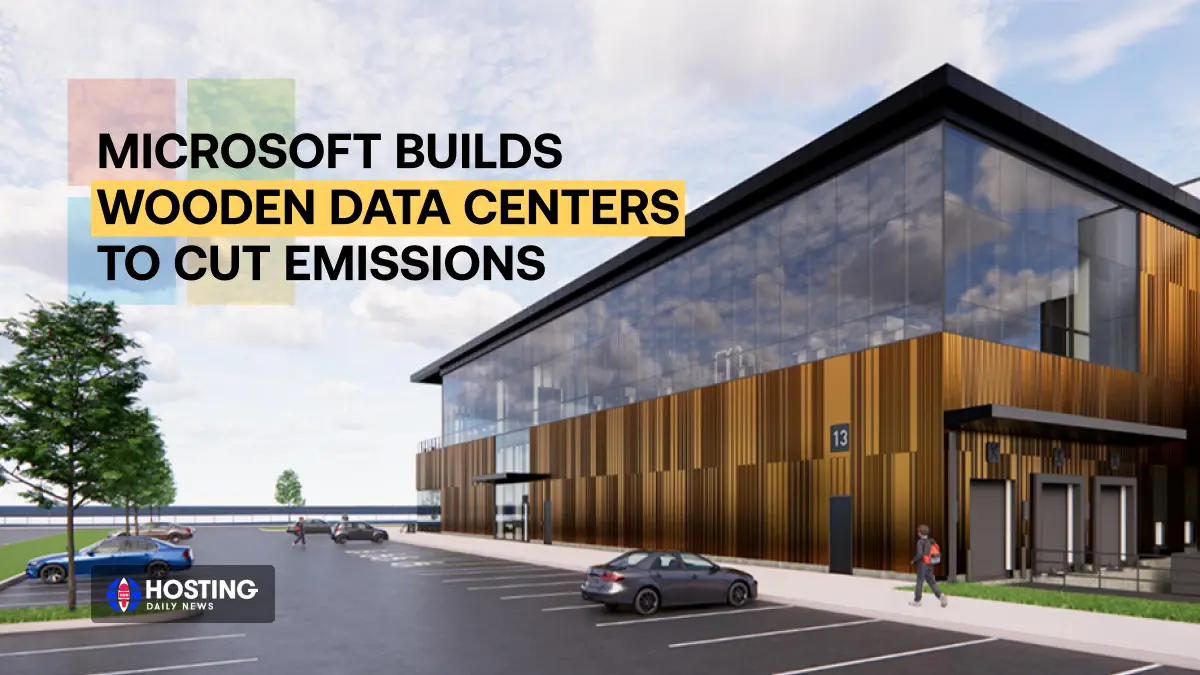
To meet ambitious climate goals, Microsoft announced building its first data centers made from wood, replacing steel and concrete with a purpose to reduce its carbon footprint by up to 65%.
Sustainable Data Centers
In a pursuit to be carbon-negative by 2030, Microsoft is building sustainable data centers in Northern Virginia with fire-resistant prefabricated cross-laminated timber (CLT). This move aims to reduce the use of steel and concrete, responsible for significant emissions footprint. Microsoft believes using wood for its data centers will cut down its carbon footprint by 35% versus steel construction and even greater for concrete by 65%.
“The hybrid mass timber, steel and concrete construction model is estimated to significantly reduce the embodied carbon footprint of the two data centers by 35% compared to conventional steel construction, and 65% compared to typical precast concrete,” stated Microsoft in a blog post.
“The sustainably harvested [cross-laminated timber] Microsoft is using will displace a portion of the thick concrete typically used for flooring and ceilings [in data centers]. The result will be a much lighter building requiring far less steel, another factor reducing the embodied carbon of the building.”
Using Sustainable Materials
The company will not entirely build its data centers out of wood, instead it will use cross-laminated timber for the floors and ceilings and add a thinner layer of concrete on top to protect the wood and help it last longer. The only drawback of using cross-laminated timber is that it is more expensive than concrete and steel. But since it’s lighter material, the building will require less steel for support, which can save on materials and labor.
“We have to be system thinkers across the entire value chain of these materials that go into our data centers and the equipment that supplies them,” said Jim Hanna, team lead for Microsoft’s data center engineering team.
Microsoft’s 2016 Initiative
Well, this is not the first time Microsoft is looking for building data centers that are better for the environment. In 2016, they started a project to create underwater server farms. This project was finished in 2020, and the company published research showing that underwater data centers can be reliable and energy-efficient compared to traditional land-based facilities.
Innovative Partnerships
Microsoft is working with companies that make green building materials to cut down on carbon emissions. One partner is Sweden based Stegra, which is creating a steel-making process that uses hydrogen and only emits water vapor. Another partner is Boston Metal, which produces steel using renewable electricity and releases oxygen. Microsoft collaborated with CarbonCure, which adds carbon dioxide to concrete, and Prometheus Materials, which creates cement without carbon using microalgae. Microsoft is planning to test this cement in Virginia to check its durability.
By introducing wood-based construction in data centers and choosing a more sustainable route, Microsoft is one step closer towards green technology and a carbon-neutral future.
