
Google has clarified its site reputation abuse policy, which google had launched earlier this year in May by updating the policy language about violation of Google’s guidelines.
In the recent search engine ranking updates, Google has issued new clarification on its site reputation abuse policy. Google launched its site reputation abuse policy earlier this year. This update was made to close the loopholes which publishers are leveraging to generate affiliate revenue.
It simplifies that using the third-party content to exploit a site’s ranking is a violation of guidelines issued by Google.
The Reason Behind Clarification
Google, in its blog told the reason behind this clarification, says, “Since launching the policy, we’ve reviewed situations where there might be varying degrees of first-party involvement, such as cooperation with white-label services, licensing agreements, partial ownership agreements, and other complex business arrangements.”
“Our evaluation of numerous cases has shown that no amount of first-party involvement alters the fundamental third-party nature of the content or the unfair, exploitative nature of attempting to take advantage of the host’s sites ranking signals.”
“We’re clarifying our policy language to further target this type of spammy behavior. We’re making it clear that using third-party content on a site to exploit the site’s ranking signals is a violation of this policy — regardless of whether there is first-party involvement or oversight of the content.”
What is Site Reputation Abuse?
Site Reputation Abuse happens when a website hosts the pages which third parties published with minimal oversight from the host website. The main aim of these pages is to manipulate search ranking. This third-party content is not directly related to the main theme of the host website. This practice is generally known as “Parasite SEO.”
Impact of Site Reputation Abuse Policy
Beginning in July, the search visibility of the Forbes, Wall Street Journal, CNN, Fortune, and Time affiliate operations dropped sharply.
Between Sept. 12 and Oct. 31, search visibility declined 43% at Forbes Advisor, 77% at WSJ Buy-Side, 63% at CNN Underscored, 72% at Fortune Recommends, and 97% at Time Stamped, according to data compiled for ADWEEK by Sistrix.
What is Included in Google’s Site Reputation Abuse Policy?
These are the example of violation of Google’s policy:
- An educational site hosting a page about reviews of payday loans written by a third-party that distributes the same page to other sites across the web.
- A medical site hosting a third-party page about “best casinos” that’s designed primarily to manipulate search rankings by taking advantage of the medical site’s ranking signals.
- A movie review site hosting third-party pages about topics that would be confusing to users to find on a movie review site.
- A sports site hosting a page written by a third-party about “workout supplements reviews”, where the main purpose of hosting the page is to manipulate search rankings.
- A news site hosting coupons provided by a third-party where the main reason for publishing the coupons on the news site is to capitalize on the news site’s reputation.
These are the “exceptions” for site reputation abuse:
- Wire service or press release service sites
- News publications that have syndicated news content from other news publications
- Sites designed to allow user-generated content, such as a forum website or comment sections
- Columns, opinion pieces, articles, and other work of an editorial nature
- Third-party content (for example, “advertorial” or “native advertising” type pages) where the purpose is to share content directly to readers (such as through promotion within the publication itself), rather than hosting the content to manipulate search rankings
- Embedding third-party ad units throughout a page or using affiliate links throughout a page, with links treated appropriately
- Coupons that are sourced directly from merchants and other businesses that serve consumers
How Did Users React to This Update?
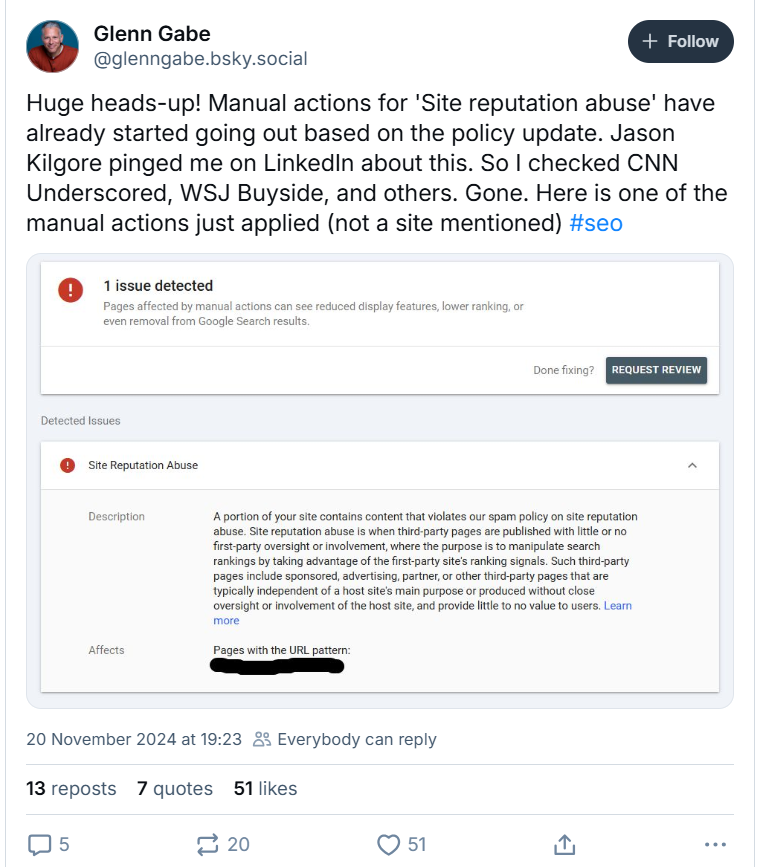
Image Source: https://bsky.app/profile/glenngabe.bsky.social/post/3lbf3vyyfpc2p
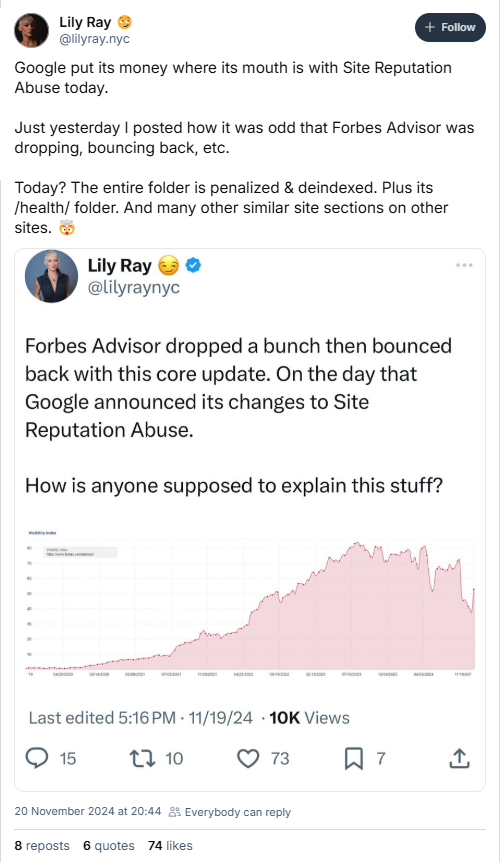
Image source: https://bsky.app/profile/lilyray.nyc/post/3lbfahnlkga2y
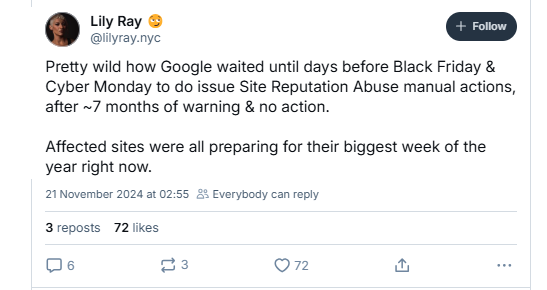
Image source: https://bsky.app/profile/lilyray.nyc/post/3lbfv6hyunk2l
Google’s Response to Site Owners
Google mentioned in its blog mentioned that site owners who received “spam manual action” reports will be notified via their registered search console. Site owners can submit their reconsideration request.
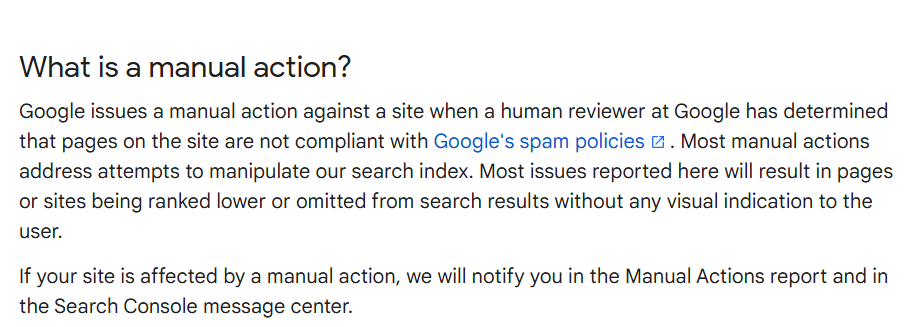
Image source: https://support.google.com/webmasters/answer/9044175
